
From our Substack
What ChatGPT Guessed About Our Workout Plan
Two prompts, two plans, and one detail we forgot to type.
We typed five words into ChatGPT.
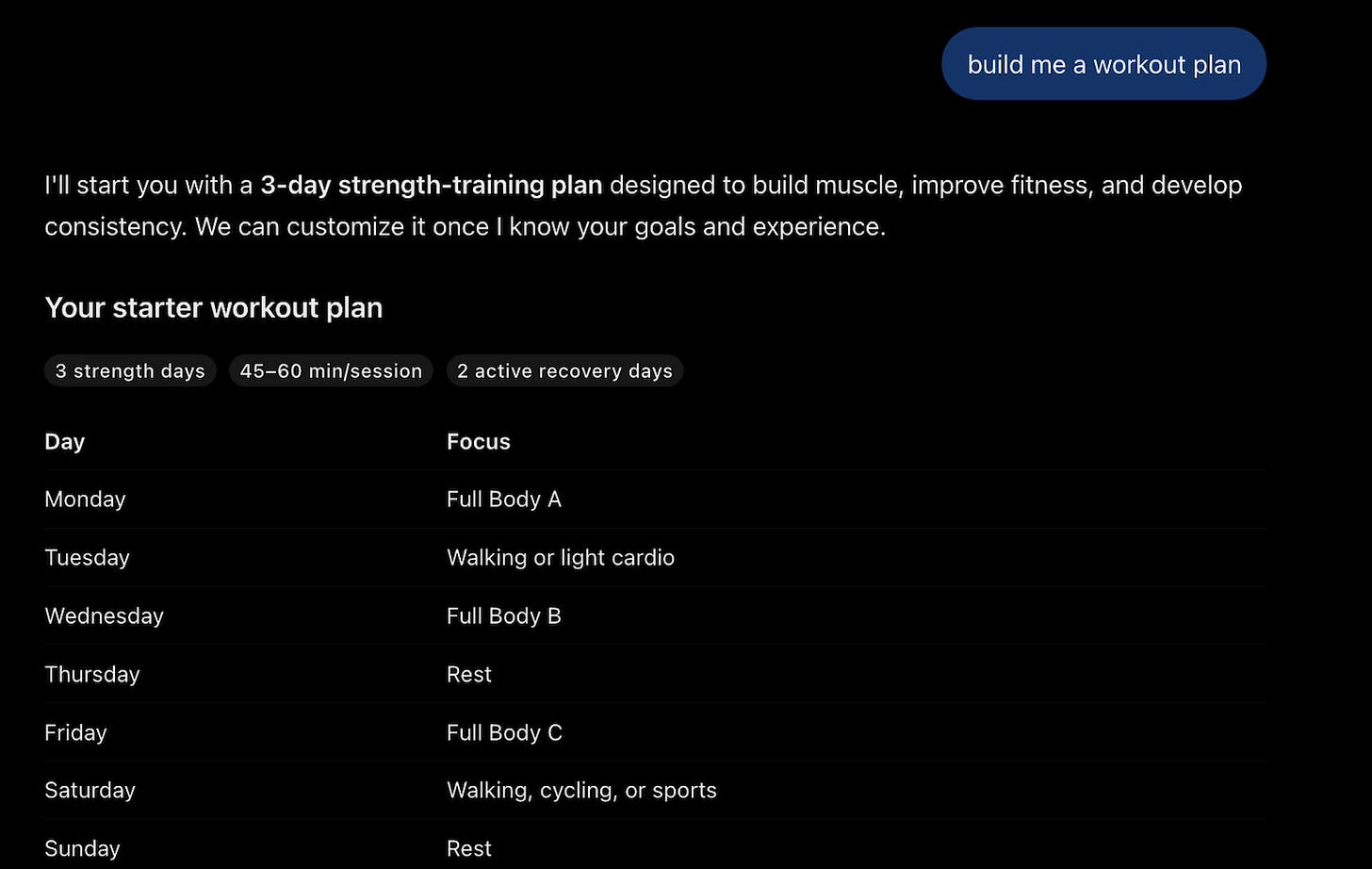
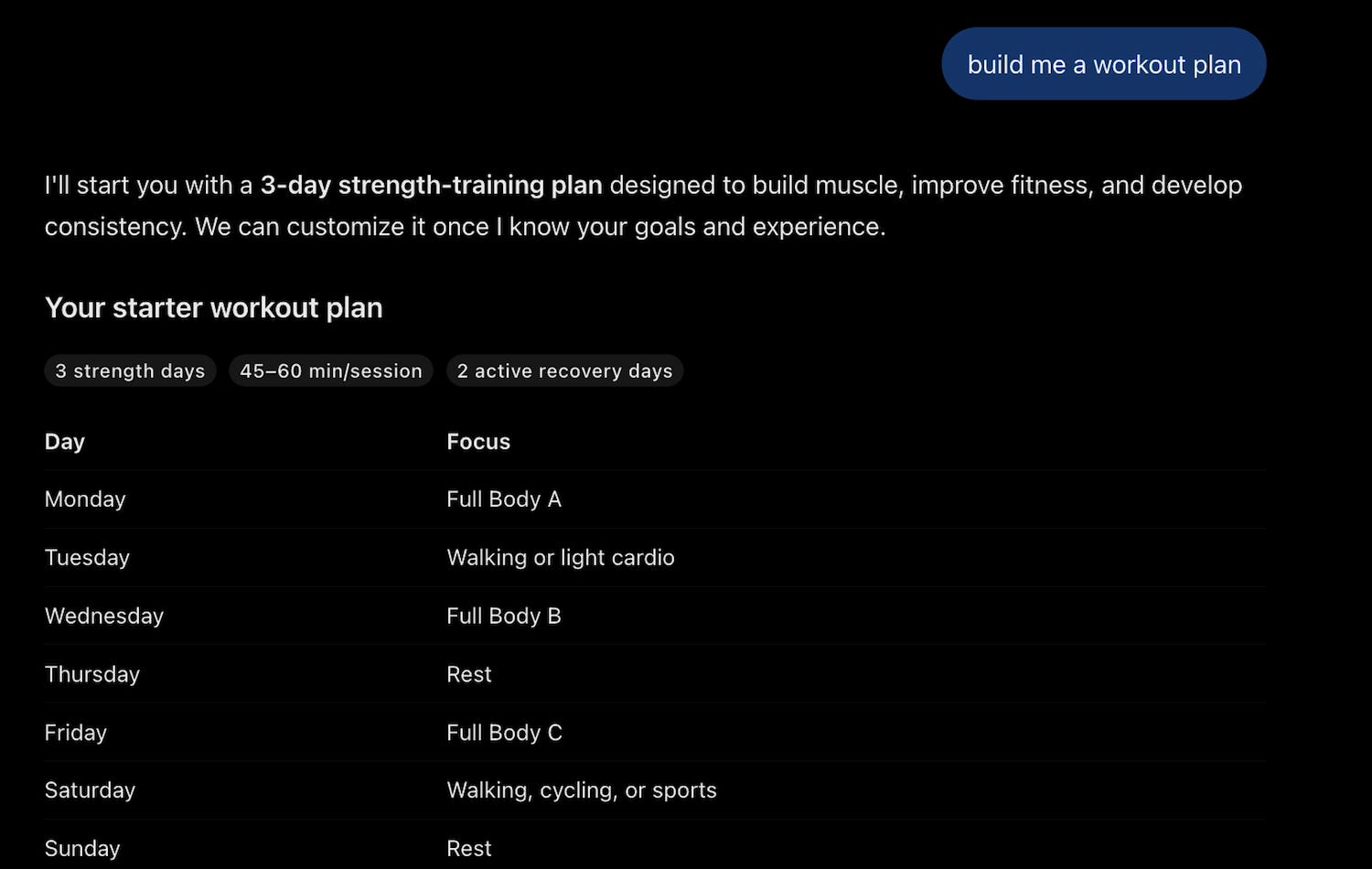
build me a workout plan
It gave us a whole week. Strength training on Monday, Wednesday and Friday. A walk or some light cardio on Tuesday. Monday started with squats, bench presses and rows. There were even photos showing how to do the exercises.
Honestly, it looked pretty good. Then we scrolled down.
Below the plan was a form asking about our goal, experience, equipment and schedule. A few options were already selected, including four days a week. The plan above it had three strength days. Both sounded plausible. We’d picked neither.
If you’re curious what a gym routine looks like, that first answer gives you something to react to. The moment you’re thinking about following it, the details start to matter. A 60-minute session might be fine on Saturday and impossible after work. A bench press might be familiar to someone who’s been lifting for years and the exercise a beginner spends ten minutes trying to set up.
So we tried giving ChatGPT a week we could actually imagine following.
Give it the details that would change the plan
Here’s what we typed the second time.
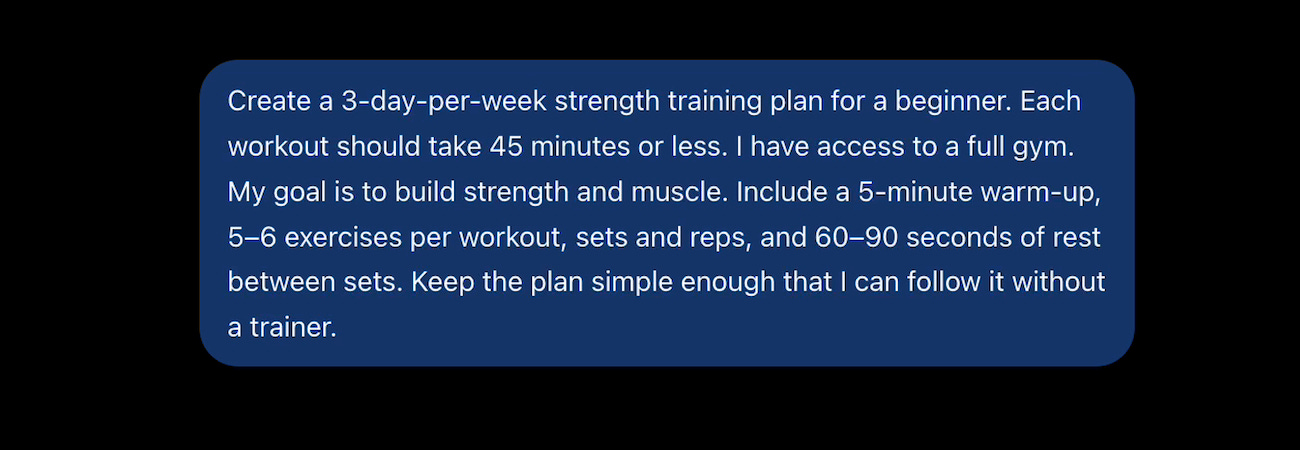
Create a 3-day-per-week strength training plan for a beginner. Each workout should take 45 minutes or less. I have access to a full gym. My goal is to build strength and muscle. Include a 5-minute warm-up, 5–6 exercises per workout, sets and reps, and 60–90 seconds of rest between sets. Keep the plan simple enough that I can follow it without a trainer.
This time, the answer said each session would take 40–45 minutes. The warm-up actually added up to five minutes. And the rest times came with a simple rule. Take 90 seconds after more demanding exercises and 60 seconds after smaller ones.
The part we found most interesting was what happened to Monday. The first plan started with squats and a bench press. The second started with a leg press and a machine chest press. ChatGPT explained that it had chosen straightforward exercises, machines and dumbbells so a beginner could follow the plan independently.
That last sentence in our prompt had seemed like a small addition. But simple enough to follow without a trainer gave ChatGPT a way to choose between exercises that could serve the same goal. If you’re writing a prompt of your own, it’s worth asking what would make the result easy for you to use. Here, it meant being able to walk into the gym and get started on our own.
Read the answer like you’re about to use it
The second plan looked ready. Then we got to the tracker.
It had 24 boxes, one for each session across eight weeks.
We’d wanted a three-month plan from the beginning. When we went back to read both prompts, we realised we’d left out the duration both times.
The tracker is what made this easy to miss. Twenty-four boxes make eight weeks look like a decision you already agreed to. And if you read the answer with the prompt beside it, there’s very little to catch. Three sessions a week? Yes. Five-minute warm-up? Yes. The missing requirement was still in our heads.
A follow-up could be as simple as this.
Make this a 12-week plan. Keep the three weekly sessions and the 45-minute limit, and show me what changes from one month to the next.
That last part matters. If you’re going to spend three months following a plan, you’ll want to know whether week nine asks you to do anything differently from week one. A longer tracker alone would leave that question open.
Try it with your last prompt
Open something you recently asked AI to make. Read it as if you were going to use it tomorrow. Where would you have to stop and make a decision?
Say it gave you a weekend itinerary. You might be perfectly happy to let it pick a lunch spot. Then you notice it’s sending you across town at 6:30, when you need to be back at the hotel by seven. Now you know exactly what to ask it to change.
If you find a guess that looked so settled you nearly planned around it, hit reply and tell us. Ours came with 24 little boxes.